FSL Santa Claus Ornament: Bringing 3D Holiday Magic to Life
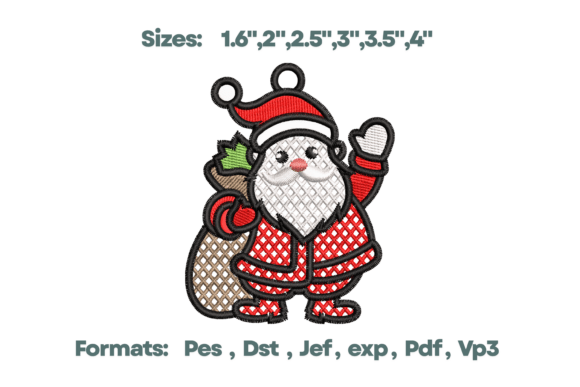
There is a distinct joy in seeing a flat piece of fabric transform into a tangible, three-dimensional object that captures the spirit of the season. The FSL Santa Claus Ornament design does exactly this, offering crafters and small business owners a digital key to creating delightful, free-standing lace decorations. Unlike traditional appliqué or satin stitch designs that rely on backing fabric for structure, this pattern utilizes a charming cross-hatch waffle technique to build its own sturdy form. When stitched correctly on water-soluble stabilizer, the result is a cheerful Santa waving hello with a sack full of gifts, standing tall without any external support.
This isn't just another embroidery file; it is a versatile tool for adding depth and texture to holiday projects. Whether you are looking to elevate your personal gift-giving game or stock your Etsy shop with unique inventory, understanding how to leverage this specific design can significantly impact the quality and appeal of your finished products.
The Versatility of Free-Standing Lace in Holiday Crafting
The primary advantage of the FSL Santa Claus Ornament lies in its structural integrity and visual lightness. Because the design is digitized to create a strong lace structure, it eliminates the bulk often associated with layered fabrics. This makes it an ideal choice for several real-world scenarios where weight and drape matter.
For instance, consider the challenge of decorating a tiered tray. Traditional heavy ornaments can sometimes tip over delicate ceramic stands or cast harsh shadows that obscure other items. A free-standing lace Santa, however, adds a whimsical, airy touch. Its open-work nature allows light to pass through, creating soft, festive shadows when placed near a candle or under warm holiday lighting. This makes it perfect for centerpieces, mantel displays, and table settings where visual balance is crucial.
Beyond home decor, the scale of this design opens up opportunities for wearable art. The intricate detailing of the cross-hatch pattern holds up remarkably well even when scaled down. Many crafters have successfully used this pattern to create elegant earrings or brooches. Imagine a pair of dangling earrings featuring a tiny, waving Santa; the 3D effect catches the eye in a way that flat printed charms simply cannot. For jewelry makers, this offers a way to incorporate textile art into metalwork or resin pieces, creating a hybrid aesthetic that feels both handmade and sophisticated.
Empowering Small Businesses and Craft Entrepreneurs
In the competitive world of handmade goods, differentiation is everything. The FSL Santa Claus Ornament provides a distinct edge for small businesses aiming to sell high-value, low-volume items. Because the design requires skill and patience to finish—washing away the stabilizer and shaping the final piece—it commands a higher price point than mass-produced alternatives.
Gift tag designers find this pattern particularly useful. Instead of attaching a paper tag to a ribbon, a crafter can embroider a small version of the Santa figure directly onto a ribbon loop or attach it as a standalone charm. This transforms a simple package into a memorable unboxing experience. Clients often appreciate the tactile nature of these tags, noting that they feel more substantial and thoughtful than standard cardstock.
Furthermore, the "must-have" status of this digital download stems from its reliability. Expert digitization ensures clean edges, which is critical for professional sellers. Nothing undermines a brand's reputation faster than frayed threads or uneven shapes. With this pattern, the risk of structural failure is minimized, allowing entrepreneurs to focus on marketing and sales rather than troubleshooting stitching errors. It is a resource that scales well; once the technique is mastered, a single machine can produce dozens of identical, high-quality ornaments in a short period, making it viable for fulfilling larger orders during the peak holiday rush.
Practical Considerations for Success
While the potential for creativity is endless, working with free-standing lace requires a shift in mindset compared to standard embroidery. The most critical factor is the choice of stabilizer. Water-soluble stabilizer is non-negotiable here. It acts as the temporary foundation upon which the Santa is built. If the stabilizer is too thin, the design may pucker or collapse before the cross-hatch pattern locks it into place. Conversely, if it is too thick, removing it later becomes a tedious struggle that risks distorting the delicate lace.
Crafters should also pay close attention to thread tension. The waffle pattern relies on consistent tension to maintain its shape. Too loose, and the Santa will look floppy; too tight, and the lace might curl inward, hiding the details of his face and sack. Testing the design on a scrap piece of stabilizer before committing to expensive thread is a wise precaution. This trial run helps identify the perfect hoop size and tension settings for your specific machine.
Another consideration is the finishing process. Once the embroidery is complete, the stabilizer must be washed away gently. Rushing this step can lead to tears in the lace. Patience is required to soak the piece until the stabilizer dissolves completely, leaving only the embroidered structure. Afterward, drying the ornament flat or pinning it to a foam block helps it retain its intended 3D shape. These steps, while requiring time, are what separate a good project from a great one.
Adapting the Design for Different Audiences
The appeal of the FSL Santa Claus Ornament extends across various demographics. For the hobbyist aged 40–50 who enjoys slow crafting, the process of washing and shaping the lace offers a meditative break from screen-heavy work. It reconnects them with the tactile satisfaction of needlecraft, updated for modern machines.
For younger crafters in their 20s and 30s, the design serves as a gateway to more complex textile techniques. It introduces concepts like negative space and structural stitching in a forgiving, fun context. The resulting ornaments are highly "Instagrammable," fitting perfectly into the aesthetic of modern, minimalist holiday decor that favors texture over clutter.
Even within the corporate gifting sector, this design has found a niche. Companies looking for eco-friendly, plastic-free promotional items can commission batches of these ornaments. They serve as durable keepsakes that employees actually want to keep, unlike typical branded merchandise that ends up in a drawer. The ability to customize the color palette to match a company's branding while maintaining the intricate lace structure makes it a flexible solution for corporate needs.
Maximizing the Creative Potential
To truly get the most out of this design, think beyond the obvious. While it is marketed as an ornament, its applications are limited only by imagination. Use it as a focal point for a wreath, stitching multiple Santas of varying sizes to create a dynamic cluster. Incorporate it into fabric-covered boxes, using the 3D element to add relief to the lid. Or, combine it with other FSL elements, such as holly leaves or snowflakes, to create a complete scene.
The strength of the FSL Santa Claus Ornament lies in its adaptability. It bridges the gap between traditional embroidery and modern 3D crafting, offering a solution that is both practical and beautiful. By understanding the nuances of the material and the mechanics of the stitch, crafters can unlock a world of possibilities, turning a simple digital file into a cherished holiday tradition.